
Red Yeast Rice, CoQ10, and Natto Powder: Understanding the Formula
Ingredient Guide · T04
Learn what Bterlif’s label lists, what each amount means, and which questions the label cannot answer.
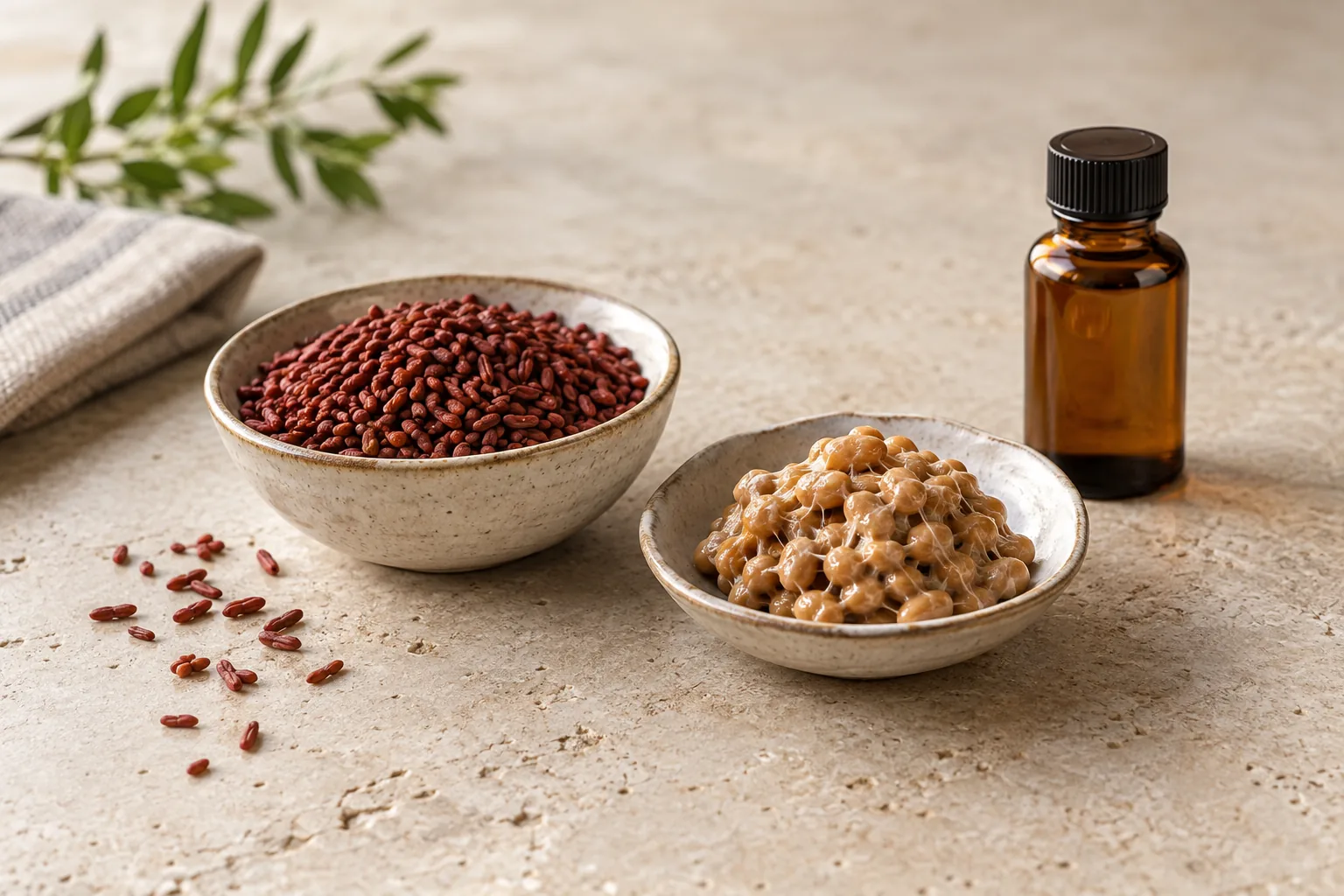
Featured image: AI-generated editorial image. Not a depiction of Bterlif’s product, packaging, raw-material specification, or clinical results.
This statement has not been evaluated by the Food and Drug Administration. This product is not intended to diagnose, treat, cure, or prevent any disease.
Three ingredients can appear together on one supplement label without becoming one interchangeable substance. Red yeast rice, Coenzyme Q10 (CoQ10), and natto powder have different origins, different ways of being measured, and different evidence and safety questions.
The current Bterlif product page lists a two-capsule serving with 1,200 mg red yeast rice powder, 100 mg Coenzyme Q10 (ubiquinone), and 40 mg natto powder. It suggests taking two capsules daily with a meal and includes warnings for people who are pregnant or nursing, taking cholesterol-lowering medication, or have liver-related concerns.1
This guide explains what those label statements tell you—and, just as importantly, what they do not establish. It is an ingredient-reading guide, not evidence of a product-specific clinical outcome. This discussion is not a claim that the Bterlif product changes cholesterol levels, replaces medication, or augments statin therapy.
The formula at a glance
FDA labeling guidance explains that a Supplement Facts panel identifies serving size, dietary ingredients, and the amount of each ingredient per serving.2 “Per serving” therefore matters: it is not automatically the same as “per capsule.”
For the Bterlif formula, the product page defines one serving as two capsules.1
| Ingredient listed by Bterlif | Labeled amount per 2-capsule serving | What the label establishes | What the amount alone does not establish |
|---|---|---|---|
| Red Yeast Rice Powder | 1,200 mg | The mass of red yeast rice powder in one labeled serving | The monacolin K content, contaminant testing, absorption, or clinical effect |
| Coenzyme Q10 (Ubiquinone) | 100 mg | The amount and named form of CoQ10 | That it prevents muscle symptoms or guarantees a cardiovascular benefit |
| Natto Powder | 40 mg | The mass of an ingredient named natto powder | A nattokinase dose, enzyme activity, vitamin K content, or clinical effect |
Labeled ingredient mass per two-capsule serving
The bars compare labeled mass only. They do not compare potency or efficacy.
Source: Bterlif product-page text reviewed September 14, 2026.
The chart is deliberately limited to mass. A longer bar does not mean that an ingredient is more potent, more important, or more effective. Milligrams of three different materials are not a common scale for comparing biological activity.
1. Red yeast rice powder: the largest amount, but not the whole story
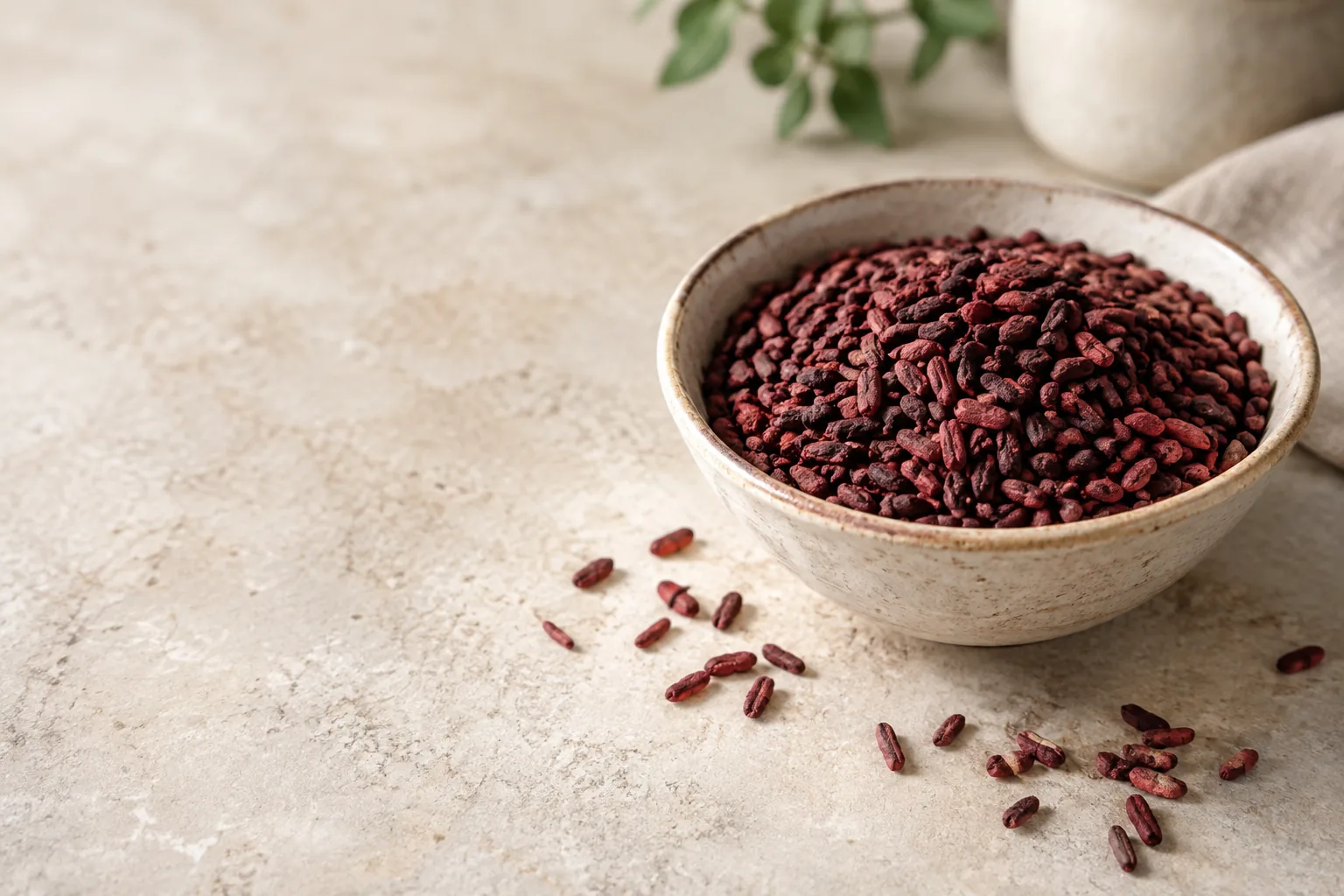
Red yeast rice is made by fermenting rice with a fungus, commonly Monascus purpureus. Depending on the strain and fermentation conditions, red yeast rice can contain compounds called monacolins. One of them, monacolin K, is structurally identical to the prescription drug lovastatin.3
That fact makes the ingredient more complicated than a simple “1,200 mg” entry suggests.
Why 1,200 mg does not tell you the monacolin K amount
NCCIH summarizes a 2017 analysis of 28 commercial red yeast rice products. Two had no detectable monacolin K; among the other 26, the amount ranged from 0.09 to 5.48 mg per 1,200 mg of red yeast rice—a variation of more than 60-fold. None of the labels in that analysis disclosed the monacolin K quantity.3
This does not tell us the monacolin K content of Bterlif’s product. It shows why the weight of red yeast rice powder cannot be converted into a monacolin K dose without product-specific testing or disclosure. The current Bterlif product-page text reviewed for this article lists 1,200 mg of red yeast rice powder but does not state a monacolin K amount.1
Safety questions matter here
NCCIH notes that red yeast rice products containing significant monacolin K may cause the same types of adverse effects and drug interactions as statins, including potential muscle, kidney, and liver harm. It also identifies citrinin, a kidney-toxic contaminant found in some red yeast rice products, as a separate quality concern.3
The practical lesson is not to assume that “natural,” the total powder weight, or the presence of other ingredients answers the safety question. Ask what the product specifically discloses and what still needs confirmation.
2. CoQ10 (ubiquinone): read the named form and keep expectations bounded

CoQ10 is a substance naturally present in the body and is also sold as a dietary supplement. The Bterlif page identifies the form in this formula as ubiquinone and lists 100 mg per two-capsule serving.14
The parenthetical name matters because it tells the reader which form is on the page. It does not, by itself, demonstrate absorption, superiority over another form, or a clinical outcome.
What the current evidence does not establish about CoQ10
The presence of CoQ10 does not establish that outcome. Such a conclusion would go beyond the label and beyond the overall evidence summarized by NCCIH. Although individual studies have had different results, NCCIH states that the evidence as a whole does not support the idea that CoQ10 reduces muscle pain caused by statins.4
That distinction is especially important in a formula containing red yeast rice. The presence of CoQ10 should not be treated as a safety shield, a reason to combine the product with a statin without advice, or proof that unwanted effects cannot occur.
CoQ10 also has interaction questions
NCCIH reports that CoQ10 may interact with warfarin and insulin and may be incompatible with some cancer treatments. Mild effects such as digestive upset or insomnia have been reported.4 Anyone in these situations should bring the exact product label—not just the ingredient name—to a healthcare professional.
3. Natto powder: a food-derived name is not an enzyme specification
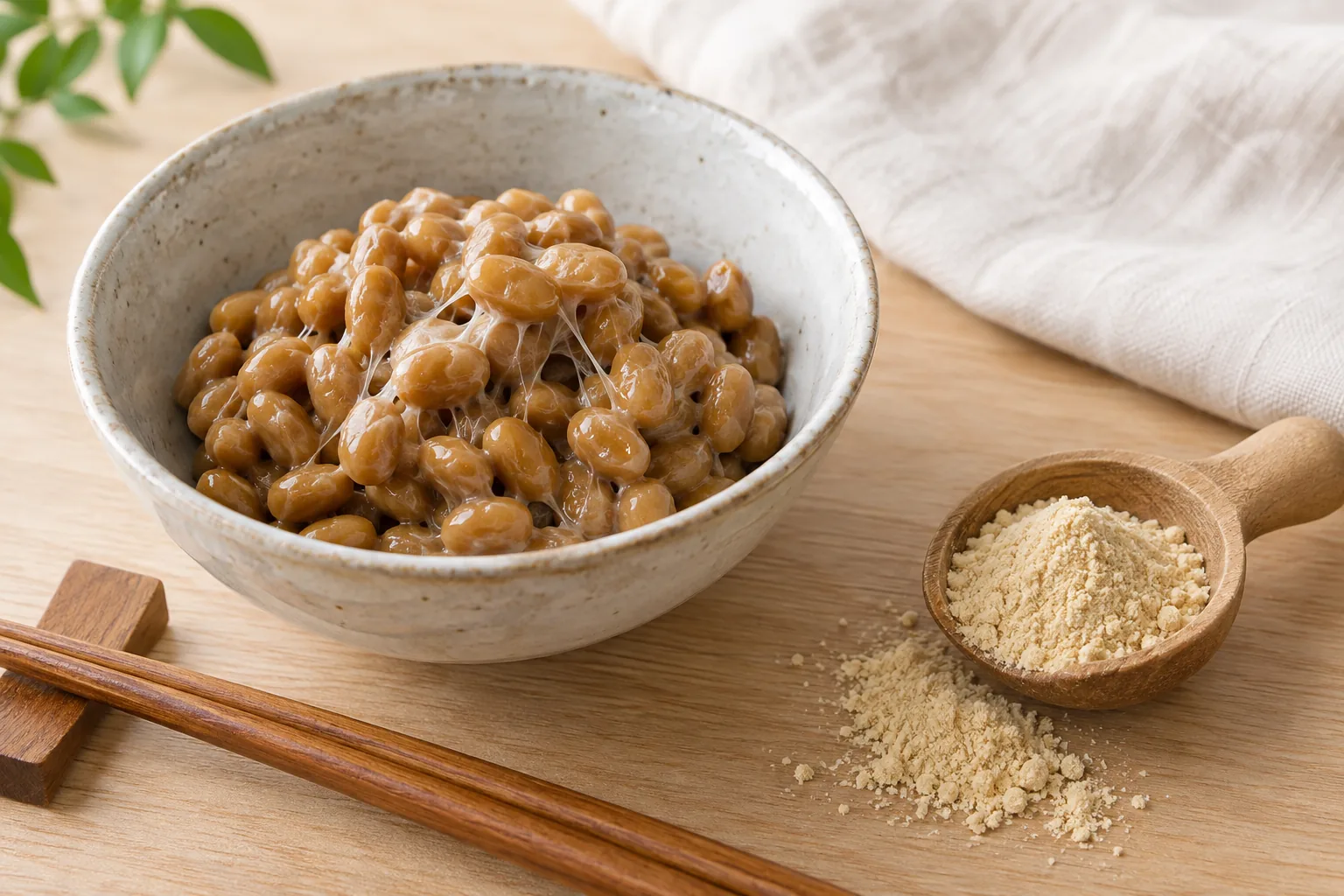
Natto is a traditional food made by fermenting soybeans with Bacillus subtilis. Reviews describe natto as a complex fermented food containing multiple components, which may include nattokinase, isoflavones, vitamin K2, and other compounds.5
The Bterlif page, however, lists Natto Powder—40 mg. It does not list “nattokinase,” an enzyme activity unit, a vitamin K amount, or the amount of any other natto-derived component in the text reviewed for this article.1
“Do not translate ‘40 mg natto powder’ into a nattokinase dose.”
Key reading rule from this guide
Natto powder and purified or standardized nattokinase are not interchangeable label descriptions. A mass in milligrams cannot establish enzyme activity unless the product supplies the relevant specification. It also should not be used to infer anticoagulant effects or compatibility with blood-thinning medication.
Because natto is produced from soybeans, people with soy allergy or sensitivity should verify the package allergen statement and contact the manufacturer if the information is not clear. The current product-page copy reviewed for this draft does not provide a complete allergen statement.
How to read a three-ingredient supplement formula
- Find the serving size. Bterlif’s page defines the listed amounts as one two-capsule serving—not one capsule.1
- Match every number to its ingredient. The three amounts are 1,200 mg, 100 mg, and 40 mg. They should not be added together and interpreted as a single active dose.
- Look for the exact form or source. The page specifies CoQ10 as ubiquinone. For red yeast rice and natto powder, additional standardized-component information is not stated in the page text reviewed.
- Separate ingredient mass from active-component data. Red yeast rice powder weight does not disclose monacolin K. Natto powder weight does not disclose nattokinase activity.
- Read warnings before benefits. Medication use, pregnancy, nursing, liver concerns, allergies, and other health conditions can change whether a supplement question belongs with a clinician or pharmacist.
- Check the physical package. Online copy can be incomplete or change over time. The package in hand should be checked for the current Supplement Facts, lot information, allergens, and warnings.
What this formula can—and cannot—be said to establish
| Statement | Stated in the product-page text reviewed on September 14, 2026? | Interpretation |
|---|---|---|
| The formula contains three listed dietary ingredients | Stated | A direct product-page description |
| A serving is two capsules | Stated | Use this basis when reading the listed milligrams |
| CoQ10 is listed as ubiquinone | Stated | Identifies the named form on the page |
| The formula contains a known amount of monacolin K | Not stated | The red yeast rice powder amount cannot supply this answer |
| Natto powder provides a known nattokinase activity | Not stated | No enzyme activity specification is stated in the reviewed page text |
| The combination is clinically proven to treat high cholesterol | Not stated | Ingredient presence and label amounts do not establish treatment efficacy |
| CoQ10 prevents red-yeast-rice or statin-related muscle effects | Not stated | NCCIH says the overall evidence does not support CoQ10 for statin-associated muscle pain |
Questions to ask before use

Bring the current label and your medication list to a qualified healthcare professional and consider asking:
- Does this product fit with my prescription and over-the-counter medicines?
- Does my history of liver, kidney, or muscle problems change the risk?
- If I take warfarin, insulin, cancer treatment, or a cholesterol-lowering medicine, is there a potential interaction?
- Does the manufacturer disclose product-specific monacolin K and citrinin testing?
- What does “natto powder” mean for this exact lot, and is any nattokinase activity standardized?
- Is there a complete soy allergen statement on the physical package?
- What symptoms should prompt me to stop and seek professional advice?
People who are pregnant or nursing should not rely on this article to make a use decision. NCCIH states that red yeast rice products are not recommended during pregnancy or lactation, and Bterlif’s product page directs these groups to consult a healthcare professional.13
Bottom line
Bterlif’s current page presents a clear starting point: 1,200 mg red yeast rice powder, 100 mg CoQ10 as ubiquinone, and 40 mg natto powder per two-capsule serving.1 Those numbers identify ingredients and mass. They do not reveal monacolin K content, citrinin testing, nattokinase activity, individual absorption, or a guaranteed health result.
Good supplement reading is partly about noticing what is present and partly about refusing to fill in what is missing. Review the current Bterlif Red Yeast Rice & CoQ10 product page, compare it with the physical package, and discuss medication or health-condition questions with a qualified healthcare professional before use.
References
- Bterlif. Red Yeast Rice & CoQ10 Capsules. Product-page text reviewed September 14, 2026. This is the source for Bterlif-specific ingredient, serving, suggested-use, and warning statements; it is not independent evidence of effectiveness.
- U.S. Food and Drug Administration. Dietary Supplement Labeling Guide: Chapter IV—Nutrition Labeling. Accessed September 14, 2026.
- National Center for Complementary and Integrative Health. Red Yeast Rice: What You Need To Know. Accessed September 14, 2026.
- National Center for Complementary and Integrative Health. Coenzyme Q10. Page last updated January 2019; accessed September 14, 2026.
- Afzaal M, Saeed F, Islam F, et al. Nutritional Health Perspective of Natto: A Critical Review. Biochemistry Research International. 2022;2022:5863887. doi:10.1155/2022/5863887.




Add comment