
Astaxanthin and Skin Health: What Human Studies Actually Show
ASTAXANTHIN · SKIN HEALTH
Astaxanthin and Skin Health: What Human Studies Actually Show
A research summary on astaxanthin supplementation and skin outcomes — what studies have measured, what they found, and where the evidence remains limited.
BTERLIF · Research Summary · Published July 20, 2026 · Reviewed July 30, 2026
These statements have not been evaluated by the Food and Drug Administration. This product is not intended to diagnose, treat, cure, or prevent any disease.
This article summarizes published research on astaxanthin and skin health. Studies discussed here used different formulations, doses, populations, and endpoints. Findings do not necessarily apply to any specific commercial product, are not usage instructions, and do not guarantee individual results. Consult a healthcare professional before starting any supplement regimen.
Key Takeaways
- Human studies have examined astaxanthin supplementation (mostly 4–6 mg/day, 6–12 weeks) for skin hydration, elasticity, wrinkle measurements, and controlled UV-response markers.
- The evidence is preliminary. Most studies are small, short-term, and some are funded by industry. A meta-analysis found statistically significant improvements in skin hydration and elasticity but not in wrinkle depth.
- Astaxanthin is not a sunscreen and should not be used as sun protection. The studies discussed here do not show that astaxanthin prevents sunburn, skin cancer, or real-world photoaging. Broad-spectrum SPF, protective clothing, and sun avoidance remain the primary means of sun protection.
What Astaxanthin Is
Astaxanthin is a carotenoid pigment produced by the microalgae Haematococcus pluvialis. It belongs to the same chemical family as beta-carotene and lutein. It is responsible for the pink-red color of wild salmon, krill, shrimp, and flamingos.
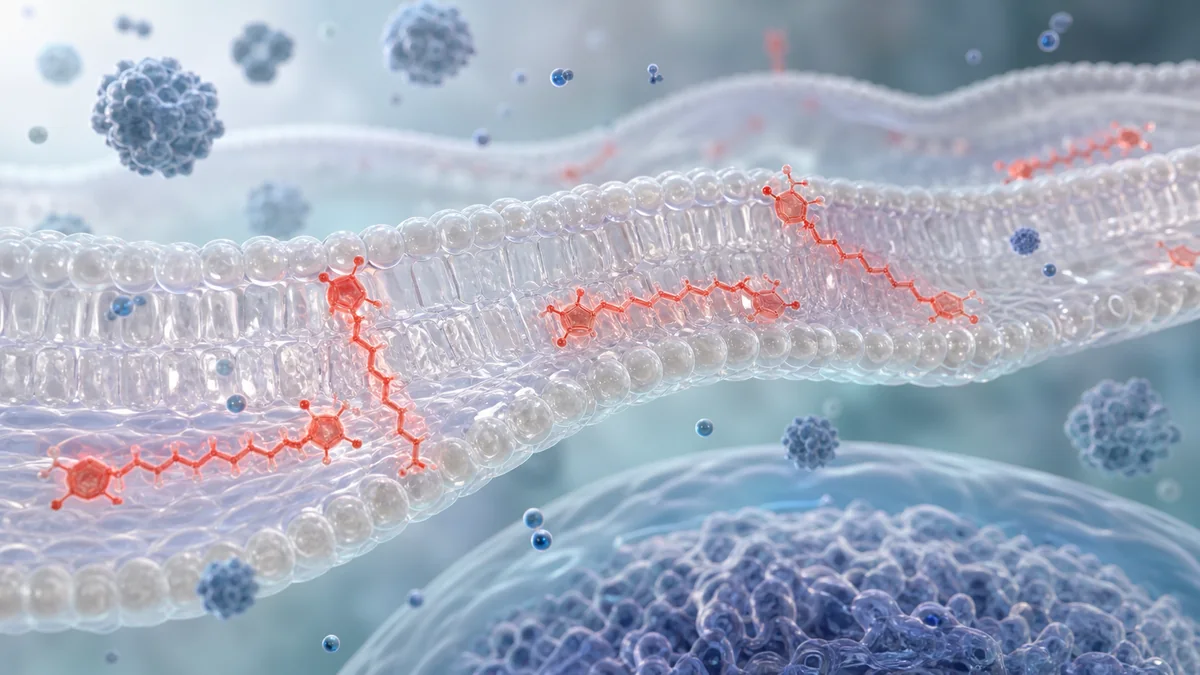
At the molecular level, astaxanthin can embed within cell membranes and neutralize certain types of free radicals. This mechanism does not by itself prove any clinical benefit for human skin — it is a biochemical property that requires human testing to evaluate whether it translates to measurable outcomes.
What Human Studies Have Evaluated
The table below summarizes key human studies on astaxanthin and skin. Each study used different formulations, doses, durations, and endpoints. None tested the product sold on this site.

| Study | Design | n | Dose | Duration | Key Endpoints | Reported Results | Limitations |
|---|---|---|---|---|---|---|---|
| Tominaga et al. 2012 | Open-label, no control | 30 women | 6 mg oral + 2 mL topical/day | 8 weeks | Crow’s feet, elasticity, pigmentation | Improvements reported in all endpoints | Open-label, no control group; oral and topical combined — cannot attribute effects to oral alone; industry-funded |
| Ito et al. 2018 | RCT, double-blind, placebo-controlled | 22 (final analysis) | 4 mg/day | 9 weeks | Minimal erythema dose (MED), skin hydration after controlled UV exposure | MED: raw post-supplementation group comparison n.s. (p=0.162); change from baseline differed between groups. Hydration loss after controlled UV exposure reduced vs. placebo. Per-protocol n=22. | Small sample; controlled UV source not equivalent to sunlight; industry-funded |
| Ng et al. 2021 (systematic review) | Review of 11 clinical studies | Varies | 2–12 mg/day | 2–16 weeks | Hydration, elasticity, wrinkles, UV endpoints | Promising signals but authors note small samples, homogenous populations, many commercial ties | Review limitations are those of the included studies |
| Zhou et al. 2021 (meta-analysis) | Meta-analysis of RCTs | Pooled analysis | Various | Various | Hydration, elasticity, wrinkle depth | Statistically significant for hydration and elasticity; wrinkle depth n.s. | Limited number of RCTs available for pooling; results may not be clinically meaningful |
| Tominaga et al. 2017 | RCT, double-blind, placebo-controlled | 65 women | 6 mg/day or 12 mg/day | 16 weeks | Skin hydration, elasticity, wrinkle depth, roughness | Improvements reported in hydration, elasticity, and wrinkle parameters at both doses | Industry-affiliated authors; study conducted over winter when UV exposure is low; does not test Bterlif product or formulation |
What the Evidence Suggests — and What It Does Not
Skin Hydration
The meta-analysis by Zhou et al. (2021) found a statistically significant improvement in skin hydration across pooled RCT data. The magnitude of change and its clinical relevance remain to be established.
Skin Elasticity
The same meta-analysis reported a statistically significant improvement in skin elasticity. Individual study effects varied, and the total number of pooled participants was small.
Wrinkle Depth
Wrinkle depth did not reach statistical significance in the meta-analysis. Several individual studies reported positive findings, but the pooled analysis did not confirm a consistent effect. This is an area where current evidence does not support a firm conclusion.
Controlled UV-Response Research Is Not Sunscreen Protection
One double-blind study (Ito et al., 2018) measured changes in minimal erythema dose (MED) after 9 weeks of 4 mg/day astaxanthin. The raw MED group comparison was not statistically significant (p=0.162). A secondary analysis of the change from baseline showed a significant difference between groups. The final per-protocol analysis included 22 participants.
What this does not mean: It does not mean astaxanthin prevents sunburn, skin cancer, or photoaging under real-world conditions. The UV source was artificial, the duration was short, and the sample was small. Astaxanthin is not a substitute for broad-spectrum sunscreen, protective clothing, or sun-avoidance strategies.
Current dermatological guidance continues to emphasize SPF 30+ sunscreen, reapplication every two hours, and seeking shade during peak UV hours.
Doses Used in Research
Clinical studies on astaxanthin and skin have used doses ranging from 2 mg to 12 mg per day, with most falling in the 4–6 mg range. These are research protocols — they are not FDA-established recommended doses and do not constitute usage instructions for any specific product.
The product sold on this site contains 12 mg per capsule. Note: Tominaga et al. (2017) included 6 mg/day and 12 mg/day oral astaxanthin research arms over 16 weeks. However, that study formulation and design do not constitute evidence for any specific commercial product.
Safety and Important Limitations

The studies summarized above are short-term (2–16 weeks) and conducted in small, relatively homogeneous populations. This is not sufficient to establish long-term safety or effects across diverse populations.
If you are pregnant, nursing, taking prescription medication, or have a medical condition, consult a healthcare professional before using any supplement.
Across the small, short-term studies summarized here, reported adverse events were limited. These data are not sufficient to establish long-term safety, safety for all populations, or safety for this specific commercial product. Follow the label instructions. Keep out of reach of children.
FAQ
How strong is the evidence that astaxanthin affects skin?
There is preliminary evidence from small, short-term studies. A meta-analysis found statistical signals for hydration and elasticity but not for wrinkles. Independent replication in larger, longer, more diverse populations is needed before conclusions can be drawn.
Does astaxanthin replace sunscreen?
No. The studies discussed in this article do not show that astaxanthin can replace sunscreen. Use broad-spectrum sunscreen, protective clothing, and sun avoidance as primary sun-protection measures.
What doses have studies used?
Research doses range from 2 mg to 12 mg per day, with most studies in the 4–6 mg range. These are not FDA-recommended doses and do not serve as usage instructions for any commercial product.
Related Reading
References
- Tominaga K, Hongo N, Karato M, Yamashita E. Cosmetic benefits of astaxanthin on humans subjects. Acta Biochim Pol. 2012;59(1):43-47. PMID:22428137.
- Ito N, Seki S, Ueda F. The Protective Role of Astaxanthin for UV-Induced Skin Deterioration in Healthy People—A Randomized, Double-Blind, Placebo-Controlled Trial. Nutrients. 2018;10(7):817. doi:10.3390/nu10070817.
- Tominaga K, Hongo N, Karato M, Yamashita E. The effect of astaxanthin on skin condition. J Clin Biochem Nutr. 2017;61(1):33-39. PMID:28751807; PMC5525019.
- Ng QX, De Deyn MLZQ, Loke W, et al. Effects of Astaxanthin Supplementation on Skin Health: A Systematic Review of Clinical Studies. J Diet Suppl. 2021;18(2):169-182. doi:10.1080/19390211.2020.1739187.
- Zhou X, Cao Q, Orfila C, Zhao J, Zhang L. Systematic Review and Meta-Analysis on the Effects of Astaxanthin on Human Skin Ageing. Nutrients. 2021;13(9):2917. doi:10.3390/nu13092917.
- Davinelli S, Nielsen ME, Scapagnini G. Astaxanthin in Skin Health, Repair, and Disease: A Comprehensive Review. Nutrients. 2018;10(4):522. doi:10.3390/nu10040522.
- Sztretye M, et al. Astaxanthin: A Potential Mitochondrial-Targeted Antioxidant. Antioxidants. 2019;8(12):609. doi:10.3390/antiox8120609.
This information is for educational purposes only and is not a substitute for professional medical advice. Always consult your healthcare provider before starting any supplement regimen.