Lymphatic Drainage Massage at Home: Step-by-Step Self-Care Guide
LYMPHATIC HEALTH · EDUCATIONAL GUIDE
Lymphatic Drainage Massage at Home: Step-by-Step Self-Care Guide
Learn how to perform gentle self-massage at home to support healthy lymphatic function. Step-by-step techniques for neck, armpits, abdomen, and legs.
BTERLIF · 12 min read
Lymphatic drainage massage uses feather-light pressure — not deep tissue work. The goal is to gently guide lymph fluid toward lymph nodes, not to knead muscles. The sequence matters. Always start at the neck and collarbone, work outward to armpits, abdomen, then legs. You can do this at home in 10-15 minutes with no equipment needed.
While manual lymphatic techniques are commonly used in clinical settings, some healthy individuals also use gentle self-massage as part of their wellness routine. If you wake up puffy, sit at a desk all day, or feel heavy in your legs by evening, some people report feeling a difference with a few minutes of self-massage.
Unlike deep tissue massage which targets muscles, lymphatic drainage works on the superficial vessels just beneath your skin. The pressure is light. The direction is always toward your heart. And the sequence — which nodes you clear first — matters more than the pressure itself.
“The sequence matters more than the pressure. Clear your neck first, then work outward. Feather-light is the right pressure. If you feel sore the next day, you pressed too hard.”
The Golden Rule: Clear Proximal Before Distal
This is the single most important concept in lymphatic massage, and the one most people get wrong.
Lymph nodes near the center of your body must be clear before you can drain fluid from your limbs. Think of it like a highway: clear the jam first, then traffic flows.
- Always start at your neck and collarbone. This is the terminus where lymph re-enters your bloodstream.
- Then move to armpits. These drain your arms and upper chest.
- Then abdomen. Abdominal nodes collect lymph from your lower body and digestive organs.
- Then groin, then legs last. Only drain your legs after everything above them is clear.
Step 1: Neck and Collarbone (2 minutes)
Clear the neck terminus first. This step is generally recommended before the remaining sequence.
How to do it
- Sit or stand comfortably. Use your index and middle fingers on both hands.
- Place your fingertips just above your collarbone, on either side of the hollow at the base of your throat.
- Make small, gentle circular motions — as if tracing a coin on your skin.
- The pressure should be very light. Lymph vessels sit just under the skin, not deep in the muscle.
- Continue for 30-60 seconds on each side.
- Move your fingers outward along the top edge of your collarbone, repeating the circles.
- Use a gentle sweeping motion from behind your ears down to your collarbone, 5-10 times per side.
Step 2: Armpits (2 minutes)
How to do it
- Lift one arm slightly. With your opposite hand, cup your armpit gently.
- Make slow, gentle pumping motions upward.
- Do not press hard. Axillary lymph nodes are sensitive.
- Pump 10-15 times on each side.
- With a flat palm, sweep from your inner elbow up toward your armpit. Light pressure, 5-8 times per arm.
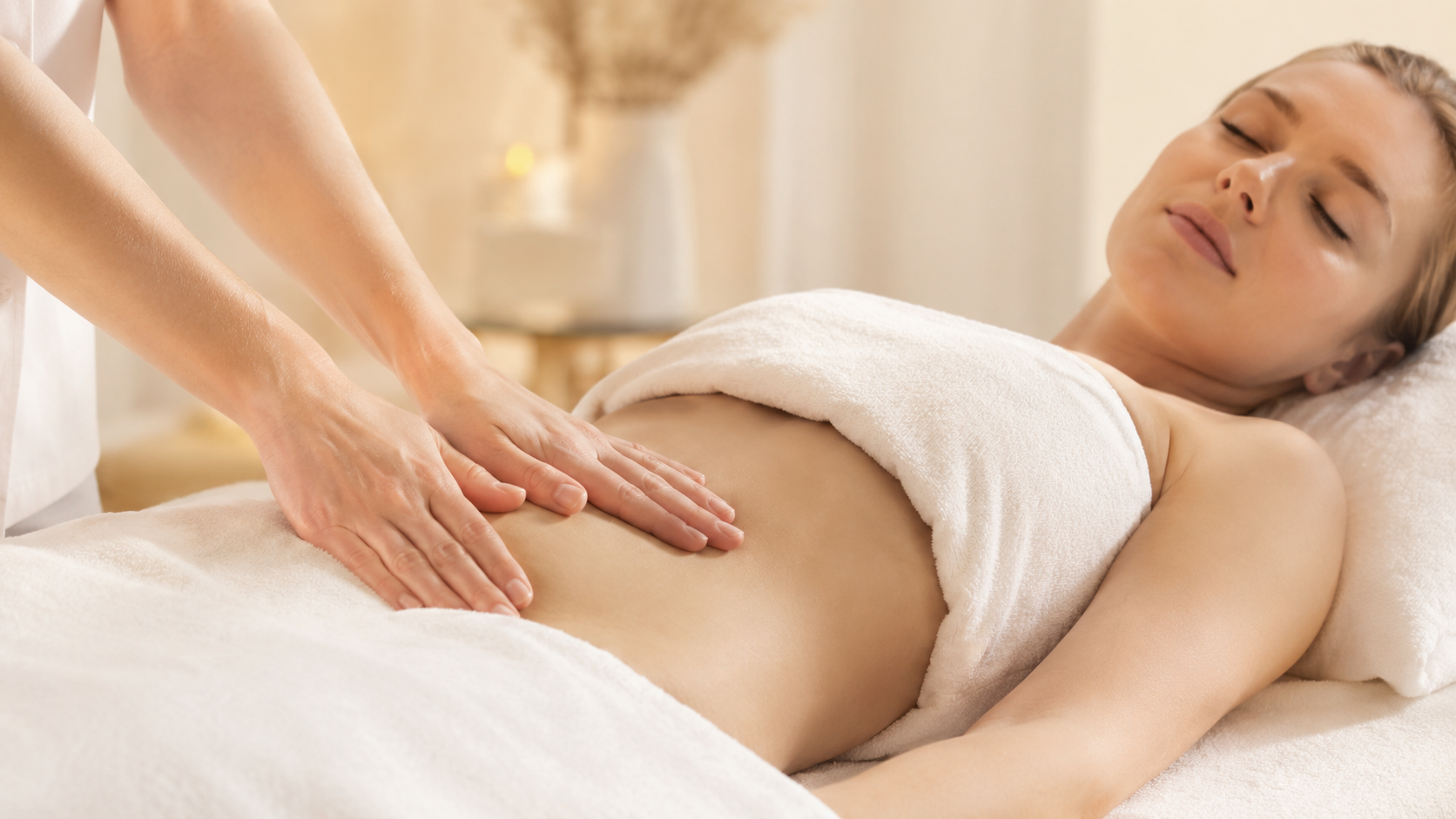
Step 3: Abdomen (3 minutes)
How to do it
- Lie on your back with knees bent, feet flat.
- Place your palm flat on your belly, just below your ribcage.
- Breathe deeply. As you exhale, trace a large clockwise circle around your navel.
- Repeat 10-15 circles with each exhale.
- Place both palms on either side of your navel. Apply gentle downward pressure toward your pelvis. Hold 5 seconds, release. Repeat 5 times.
- This area follows the general anatomical direction of abdominal lymphatic pathways.
Some individuals report a sense of warmth or gentle movement during abdominal massage.
Step 4: Groin and Legs (5 minutes)
How to do it
- Groin first: Lie with knees bent. Place fingertips in the crease where thigh meets pelvis. Gentle pumping, 10-15 times each side.
- Thighs: Flat palm, start at knee. Stroke upward toward groin with light pressure. 5-8 strokes per leg.
- Lower legs: Start at ankle. Long, sweeping strokes up the calf toward knee, then to groin. 5-8 strokes per leg.
- Feet: Gently pump the top of each foot toward the ankle. Sweep from toes toward ankle.
Tools That May Help (Optional)
- Gua Sha stone: Flat, smooth stone. Use light pressure, stroking toward the heart. Especially suited for face and neck.
- Jade roller: Roll outward from the center of your face toward your ears and down your neck.
- Dry brush: Use before massage on dry skin, always stroking toward the heart.
- Your hands: The best tool, always available. Learn the technique first. Add tools later.
After massage, rest in legs-up-the-wall pose for 5 minutes.
After Your Massage: Recovery Phase
After any lymphatic massage session, giving your body time to adjust may help support the natural recovery process:
- Drink a full glass of water. Lymph is mostly water. Staying hydrated may help the newly mobilized fluid move through.
- Rest in legs-up-the-wall pose for 5-10 minutes.
- Avoid tight clothing for the next hour.
- Avoid heavy meals immediately after. Allow 30-60 minutes.
When to Avoid Lymphatic Massage
- Active infection or fever — massage may spread localized infection.
- Blood clots or deep vein thrombosis — moving fluid toward the heart may be unsafe.
- Congestive heart failure — the heart may not handle increased fluid return.
- Active cancer — do not massage near tumor sites without oncologist approval.
- Open wounds, burns, or skin infections in the area to be massaged.
- First trimester of pregnancy — avoid abdominal massage unless approved by OB/GYN.
Daily Routine Summary
| Step | Area | Time | Technique |
|---|---|---|---|
| 1 | Neck & Collarbone | 2 min | Small circles above collarbone, sweep behind ears |
| 2 | Armpits | 2 min | Gentle pumping upward, sweep from inner elbow |
| 3 | Abdomen | 3 min | Clockwise circles, gentle downward pressure |
| 4 | Groin & Legs | 5 min | Sweeping strokes ankle to groin, pump feet |
| 5 | Drain-out | 10 min | Water + legs-up-wall rest |
“The sequence matters more than the pressure. Start at the neck and work outward. Feather-light is all you need.”
Medical Disclaimer
The information provided in this article is for educational and informational purposes only. It is not intended as medical advice, diagnosis, or treatment. Always consult a qualified healthcare professional regarding any medical condition or before starting any new health practice.
Frequently Asked Questions
How often should I do lymphatic massage?
Frequency depends on individual needs. Some people with visible puffiness practice daily, while others do it 3-4 times per week for maintenance. Even 2-3 minutes of gentle neck clearing in the morning may be helpful.
How do I know it is working?
Some individuals report a subtle sense of lightness or warmth in the area massaged. Within 30-60 minutes, rings may feel looser and facial puffiness reduced. Some people also notice increased urination — this may occur in some individuals, as the body processes the mobilized fluid.
Can I do this before or after exercise?
Both are fine. Before exercise, clearing nodes may provide more room for increased lymph flow during activity. After exercise, gentle massage may help support the body’s natural recovery process. Avoid vigorous massage on sore muscles.
Is it normal to feel tired after?
Some people report temporary fatigue after massage, especially during the first few sessions. Responses vary. Staying hydrated and resting as needed may help.
References
- Barufi, S., et al. (2021). Exercising and compression in lymphedema. Cureus.
- Cleveland Clinic. Manual Lymphatic Drainage (MLD).
- National Lymphedema Network. Position papers on lymphedema management.
- Foldi, M., & Foldi, E. (2012). Foldi’s Textbook of Lymphology.
- Zuther, J. (2013). Lymphedema Management: The Comprehensive Guide.
- Mayo Clinic. Lymphedema: Diagnosis and treatment.
Start at Neck
Clear terminus first
12 Min Routine
Full body in one session
Stay Hydrated
Water after each session
One thing to remember
The sequence matters more than the pressure. Clear your neck first, then work outward. Feather-light is all you need.

About author